



Digitalization for small and medium-sized enterprises
Digitalization has become a key issue for small and medium-sized enterprises. However, many small and medium-sized enterprises are faced with the challenge of how to make the most of the potential offered by digital transformation. In this blog, we examine the current state of digitalization and typical obstacles, and show how companies can successfully master digital transformation and remain competitive in the long term.
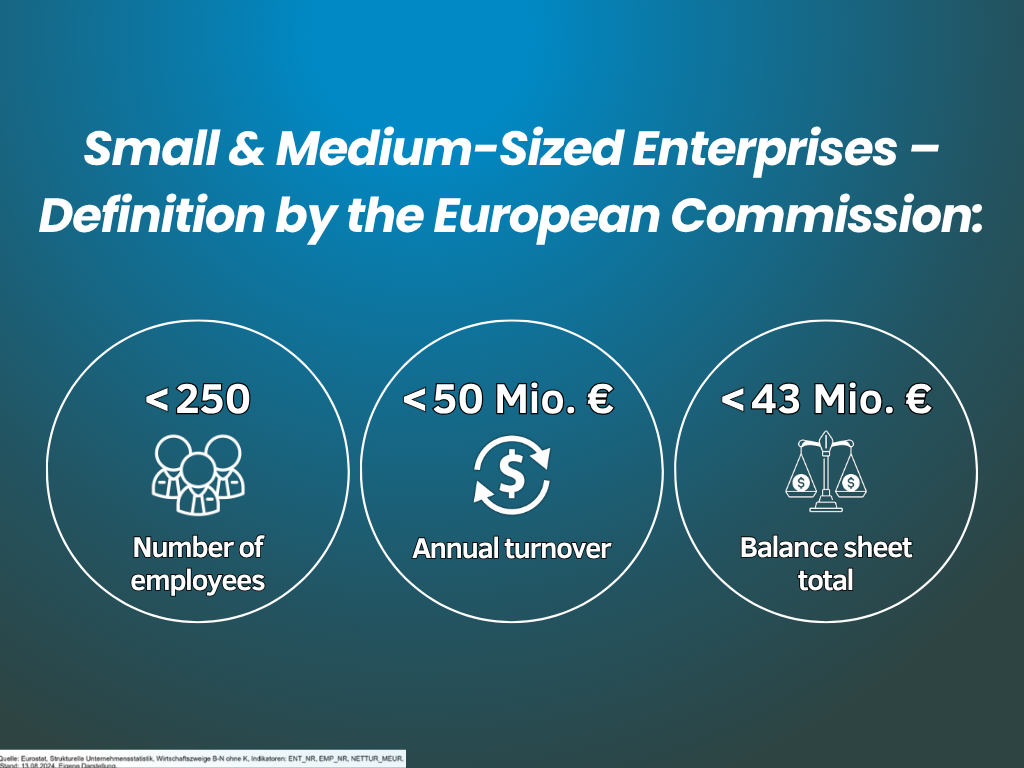
Digitalization in small and medium-sized enterprises: The key to future viability
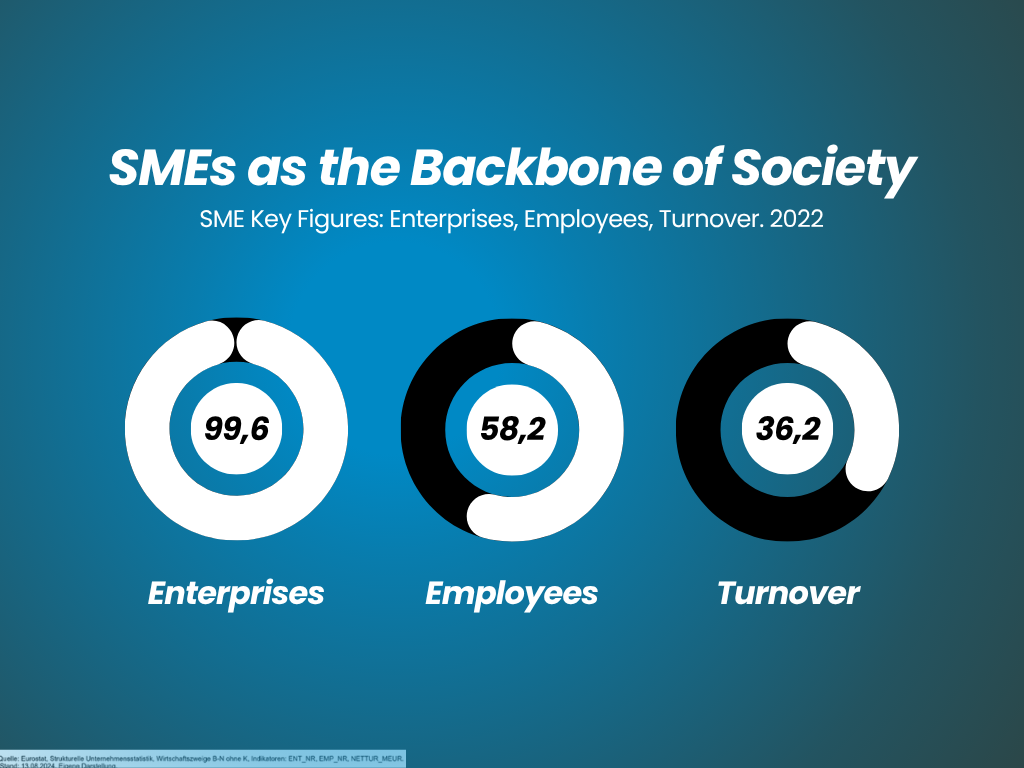
Small and medium-sized enterprises (SMEs) play a key role in the German economy. Of the approximately 2.6 million companies in Germany, over 99 percent are SMEs, which account for around 58 percent of all jobs and generate just under a third of all sales. These companies form the backbone of our economy and are crucial for social and economic stability.
In a fast-paced world, digitalization is becoming increasingly important for small and medium-sized enterprises. To remain competitive, small and medium-sized businesses must optimize their processes while taking advantage of new opportunities. Modern technologies are the key to this, as they help companies respond flexibly to change and drive innovation. But what does digitalization mean for companies in detail?
What does digitalization mean?
Digitalization refers to the shift from analog to digital processes and affects all areas of a company—from communication to customer service. It is not just about technology, but about the transformation of entire business models. For medium-sized companies, this means more efficient processes, stronger customer loyalty, and access to new markets. At the same time, digitalization requires investment in technologies and skills, as well as the adaptation of existing structures.
Digital reality in small and medium-sized enterprises: status quo and challenges
Despite the obvious advantages that digitalization can offer, recent studies show that many small and medium-sized enterprises (SMEs) in Germany face major challenges when it comes to driving digital transformation. Five key studies, including the Digitalization Index 2023, the KfW Innovation Report 2023, the DIHK Digitalization Survey 2023, and the Competence Barometer on the Skilled Labor Situation from the German Economic Institute (IW), shed light on the current state of digitalization and the hurdles that many companies have to overcome.
The 2023 Digitalization Index from the IW Cologne shows that progress in the digitalization of the German economy has stalled. Small businesses in particular are experiencing a slight decline. Technical, organizational, and structural hurdles are hindering further development. The 2023 KfW Innovation Report also confirms that innovation activities are stagnating, especially among small and medium-sized enterprises. Many companies have not yet fully regained their innovative strength after the coronavirus pandemic, which could jeopardize their competitiveness in the long term.
The DIHK Digitalization Survey 2023 provides further insights into the degree of digitalization among small and medium-sized enterprises. Companies often rate their own progress as only “satisfactory” and see room for improvement. The use of digital technologies to increase flexibility and efficiency has increased, but larger transformation projects often remain incomplete due to a lack of resources. Interestingly, the survey also shows that the use of artificial intelligence (AI) in companies has increased by 24%. Nevertheless, the shortage of skilled workers and the lack of a clear strategy remain one of the biggest challenges.
The IW's Competence Barometer also highlights that the shortage of skilled workers is a major hurdle. The shortage of qualified IT specialists, especially at higher qualification levels, is expected to worsen by 2027. This makes it difficult to implement advanced technologies such as AI and cloud computing, which are crucial for long-term competitiveness.
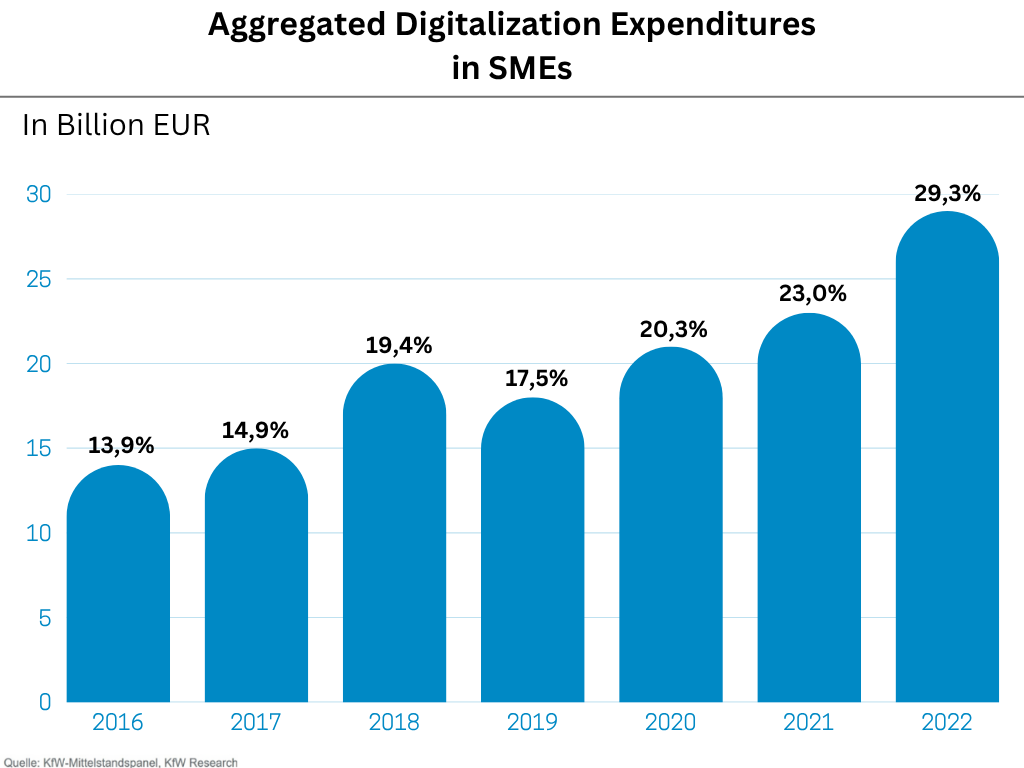
Investments and spending on digitalization
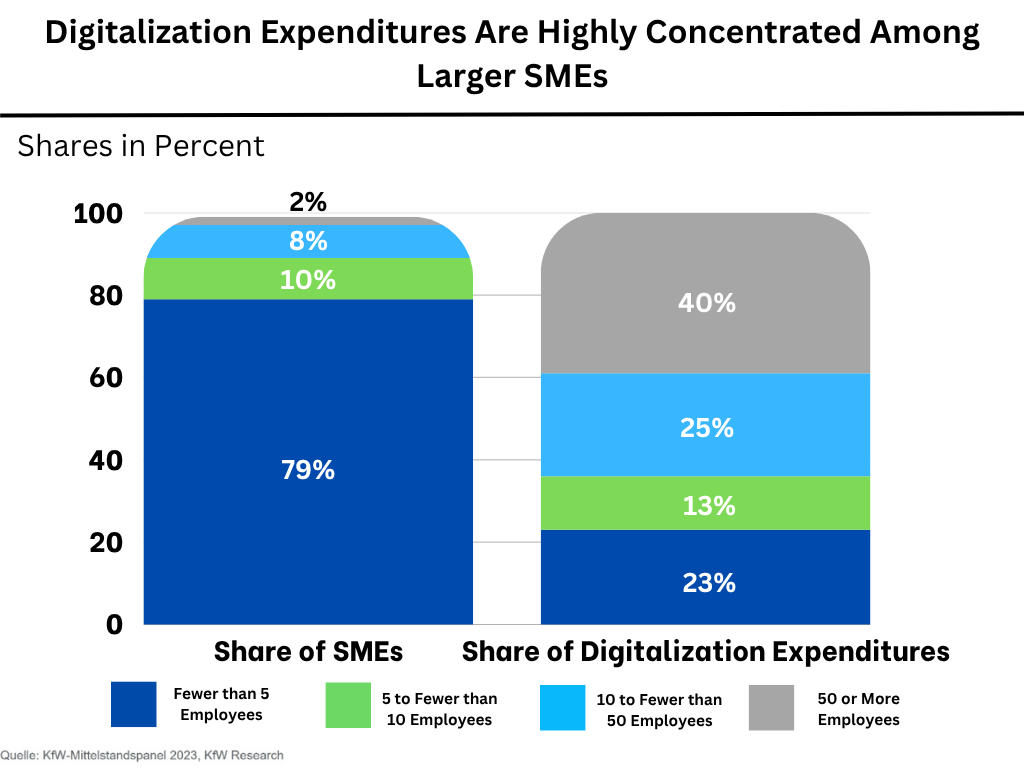
Another important aspect is willingness to invest. According to the KfW SME Panel 2024, digitization expenditure in SMEs amounted to €29.3 billion in 2022 – a significant increase compared to previous years and a sign that many companies are trying to push ahead with their digitization projects despite economic uncertainties. However, it is striking that 40% of total digitization expenditure is made by only 2% of companies, namely large SMEs. Small companies, which make up 79% of German SMEs, account for only 23% of expenditure, which highlights the imbalance in investment power.
Barriers to digitalization
Another major barrier to digitalization in German SMEs is the poor quality of internet connections. This is perceived as a major problem not only in rural areas, but also in urban centers. In addition, a lack of IT skills and a shortage of IT specialists play a decisive role. Despite targeted internal training, which 58% of German SMEs provide, many companies continue to struggle to find qualified employees who can effectively drive digitalization forward.
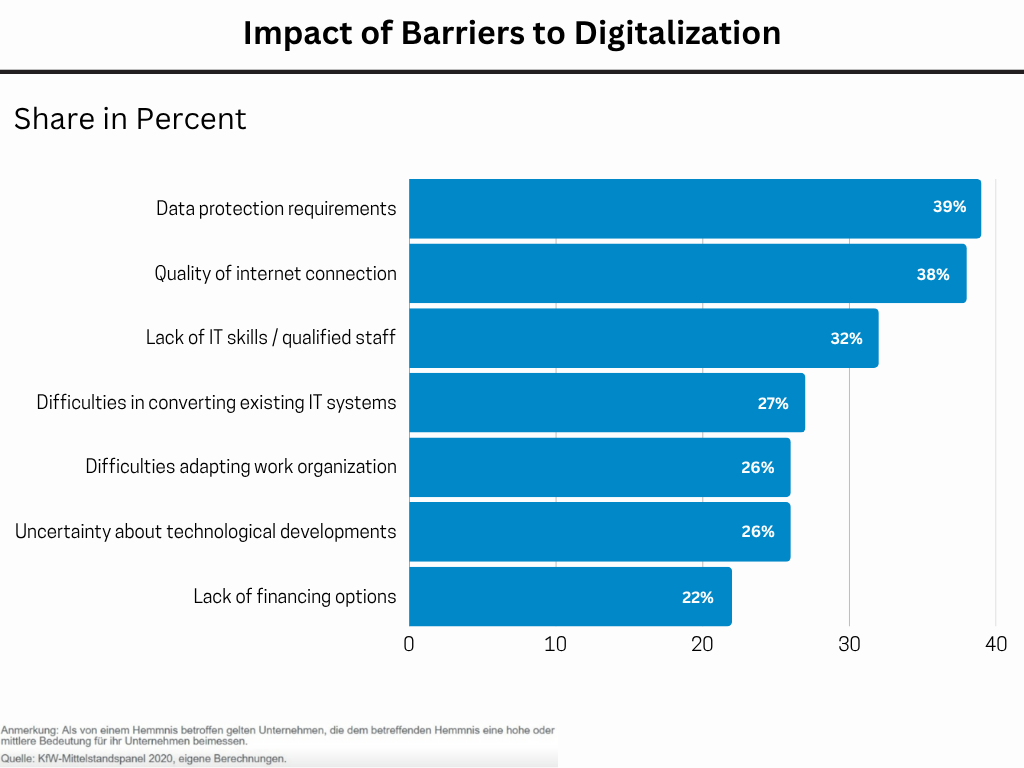
High costs and complexity of the transformation as well as legal uncertainties in handling data are also among the biggest obstacles. Studies show that 62% of companies are not pursuing any strategic goals with their digitalization measures and see digitalization more as a means of increasing efficiency and reducing costs than as a driver of innovation or new business models.
International comparison: How is Germany doing?
In a European comparison, studies show that German SMEs give digitalization a similarly high priority as their competitors in France, Spain or Poland. However, they take a more differentiated approach to implementation and focus on fewer activities. Competitive pressure appears to be less intense in Germany, as only 48% of German SMEs see the need to use new digital technologies in order to remain competitive - the European average is 54%.
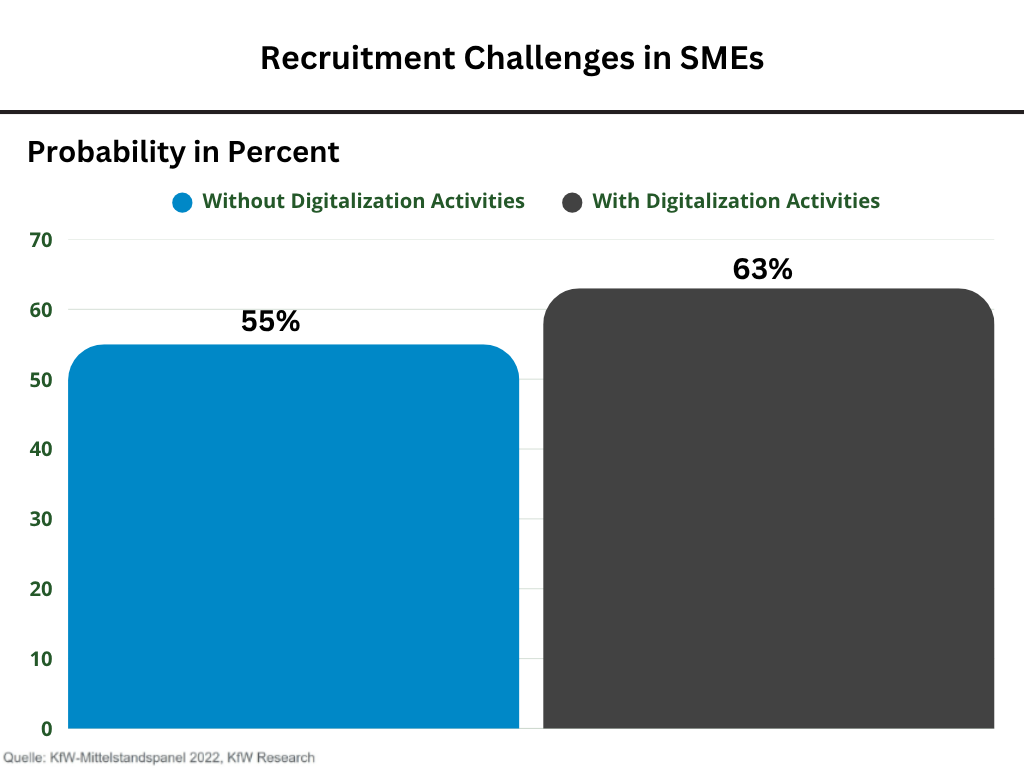
While German companies lead the way in terms of internal training, it is striking that they have significantly more problems recruiting IT specialists than their European competitors. In no other country is the shortage of skilled workers considered to be as problematic as in Germany. In the long term, this development could lead to Germany falling further behind its international competitors if no solutions are found to these problems.
Given that small and medium-sized enterprises account for 99.4 percent of all companies in Germany, a successful digital transformation of the economy cannot be achieved without the systematic digitalization of SMEs.
Mastering digitalization in SMEs: How companies can transform themselves sustainably
An open corporate culture is the key to introducing or advancing digitalization in a company. After all, digitalization can only be successfully mastered if all employees are prepared to face the challenges that a digital upheaval entails - regardless of whether they are managers or employees.
Every company can check how far it has come with digitalization. The status quo can be easily determined using the digital maturity level. This maturity level indicates how far or less far companies have progressed in their transformation process and is a tool for systematic review.
The following factors contribute to a successful digital transformation project in SMEs:
- Involvement of external consultants with expertise and foresight, e.g. Kleen Software GmbH
- Use digital platforms for marketing, sales or market development
- Recruit specialists and train employees
- Involve all employees and take a holistic approach
- Expand IT infrastructure
- Check and take advantage of funding opportunities
Funding for the digitalization of SMEs
There are already a number of initiatives designed to help SMEs drive digitalization forward. Mittelstand-Digital is a platform that offers SMEs information and practical support on the topic of digitalization in competence centers. Another funding program is the "Mittelstand Innovativ & Digital (MID)" in North Rhine-Westphalia. It is aimed specifically at small and medium-sized enterprises (SMEs) in NRW and helps to implement digital projects efficiently. Companies receive support with the digitalization of their products, services and business processes via various voucher options:
MID digitization: here, companies can obtain external expertise for the further development of digital solutions or modernize their internal processes using digital technologies.
MID analysis: This voucher enables scientific and technological expertise from universities and research institutions to be called in to carry out feasibility studies for innovative ideas.
MID innovation: Companies can further develop and test prototypes and new solutions until they are ready for the market.
Depending on the voucher variant, these grants offer amounts of up to 15,000 to 40,000 euros to help companies drive forward their digitalization efficiently and sustainably. MID thus enables access to specialist expertise, which is a decisive factor for the success of digital transformation projects for many companies.
We support them!
Digitalization in SMEs offers enormous opportunities, but requires a clear strategy and targeted support in order to master the challenges. In addition to government funding programs that provide companies with financial and advisory support for the implementation of digital projects, the choice of the right software solutions plays a decisive role in the success of the digital transformation.
We specifically address the following obstacles:
- Digital transformation made easy: Our web-based software solutions enable companies to digitize their business processes without having to invest in complex IT infrastructures. We offer scalable solutions that are adaptable for small and large companies - without the need for complex programs.
- Cloud solutions for more flexibility: With our cloud-based applications, companies can work from any location and benefit from increased flexibility. This not only makes it easier to work from home, but also to collaborate across different locations.
- Increased efficiency through automation: With the help of our automation solutions, companies can optimize their internal workflows and reduce manual processes. This not only saves time, but also increases productivity in order to remain competitive in the context of BIM and AutoCAD, for example.
- Artificial intelligence as a future technology: We are experienced in the field of artificial intelligence (AI) and offer companies simple ways to integrate AI technologies into their processes. Whether to improve workflows or automate operational processes - companies can use AI to open up new business opportunities.
In addition to our software solutions, we offer comprehensive consulting services to support companies at every step of the digitalization process. In workshops and seminars on topics such as CAD digitization or Building Information Modeling (BIM), we help to identify potential and optimize processes. With our experience in advising large and medium-sized companies in industry and construction, we are committed to making it easier for small companies to enter the digital transformation.
Get in touch with us! We will work together to successfully drive forward your digital transformation.